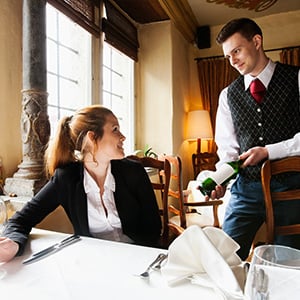
A 12-day English curriculum for a waiter, focusing on key vocabulary, phrases, and scenarios commonly encountered in the hospitality industry:
**Day 1: Greetings and Basic Phrases**
- Introduction to common greetings and phrases used in a restaurant setting
- Practice introducing yourself and asking customers how they are doing
- Roleplay scenarios for ordering food and drinks
**Day 2: Menu Knowledge**
- Vocabulary related to food items on the menu (appetizers, main courses, desserts, beverages)
- Describing dishes using adjectives (spicy, sweet, savory, etc.)
- Practice recommending dishes and answering menu-related questions
**Day 3: Taking Orders**
- Phrases for taking orders accurately and efficiently
- Handling special requests and dietary restrictions
- Roleplay exercises for taking orders from different types of customers
**Day 4: Handling Complaints**
- Vocabulary and phrases for addressing complaints and customer concerns
- Strategies for handling difficult customers
- Roleplay scenarios for resolving issues and offering solutions
**Day 5: Upselling and Recommendations**
- Techniques for upselling and making recommendations to customers
- Vocabulary for describing specials and promotions
- Roleplay exercises for upselling and suggesting additional items
**Day 6: Small Talk and Customer Service**
- Conversation starters and small talk for engaging with customers
- Polite phrases for providing excellent customer service
- Roleplay scenarios emphasizing good communication skills
**Day 7: Money and Transactions**
- Vocabulary related to bills, payments, and tipping
- Practice calculating bills, handling cash, and giving change
- Roleplay exercises for simulating transactions with customers
**Day 8: Shift Coordination**
- Vocabulary for communicating with kitchen staff and other team members
- Phrases for coordinating orders and managing workflow
- Roleplay scenarios for teamwork and effective communication during a shift
**Day 9: Special Occasions and Events**
- Vocabulary for discussing special occasions and events with customers
- Handling reservations and party bookings
- Roleplay exercises for catering to special events and large groups
**Day 10: Displaying Professionalism**
- Professional language and demeanor in the workplace
- Cultural awareness and sensitivity when interacting with international guests
- Roleplay scenarios focusing on professionalism and cultural competence
**Day 11: Health and Safety**
- Vocabulary for discussing food safety, hygiene, and health regulations
- Emergency phrases and procedures for handling safety incidents
- Roleplay exercises for scenarios focusing on health and safety
**Day 12: Setting the table**
- Vocabulary for setting the table
Additional courses and training
3-Day Workshop for Waiters
Day 1: Orientation and Introduction to Service Standards
Morning Session (9:00 AM - 12:00 PM)
Welcome and Introduction
- Meet the team and overview of the restaurant’s mission, vision, and values.
- Discuss the importance of service standards in creating a memorable dining experience.
Employee Handbook Review
- Distribute and review the employee handbook covering policies, dress code, and expectations.
- Highlight key sections on customer service etiquette and safety protocols.
Afternoon Session (1:00 PM - 4:00 PM)
Service Standards Training
- Introduce the “Steps of Service” chart detailing each phase of guest interaction.
- Role-playing exercises to practice greeting guests, taking orders, and handling complaints.
Menu Knowledge Session
- Overview of the menu items including ingredients, preparation methods, and allergens.
- Tasting session where trainees sample dishes to enhance their ability to make recommendations.
Day 2: Practical Skills Development
Morning Session (9:00 AM - 12:00 PM)
Point-of-Sale (POS) System Training
- Hands-on training with the POS system for order entry, payment processing, and managing tabs.
- Discuss common issues that may arise during service and how to troubleshoot them.
Side Work Responsibilities
- Review side work duties including setup, restocking supplies, and cleaning tasks.
- Create a checklist for opening and closing procedures specific to each station.
Afternoon Session (1:00 PM - 4:00 PM)
Shadowing Experienced Staff
- Pair trainees with experienced servers for real-time observation during lunch service.
- Focus on communication techniques, time management, and multitasking skills.
Feedback Session
- Group discussion on observations from shadowing; what went well and areas for improvement.
- Encourage questions about specific situations encountered during service.
Day 3: Advanced Techniques and Evaluation
Morning Session (9:00 AM - 12:00 PM)
Upselling Techniques Workshop
- Train on effective upselling strategies without being pushy; focus on enhancing guest experiences.
- Practice scenarios where trainees can role-play upselling appetizers or desserts.
Wine & Beverage Service Training
- Overview of wine list; discuss pairing suggestions with menu items.
- Demonstration of proper wine serving techniques including decanting if applicable.
Afternoon Session (1:00 PM – 4:00 PM)
Final Assessment & Roleplay Scenarios
- Conduct written tests covering menu knowledge, service standards, and restaurant policies.
- Roleplay various dining scenarios including handling difficult customers or special requests.
Wrap-Up & Certification Ceremony
- Provide feedback on performance throughout the workshop.
- Award certificates of completion to participants who successfully meet training benchmarks.
Top 3 Authoritative Sources Used in Answering this Question
The Fundamentals of an Effective Server Training Program
This article outlines essential components for developing a successful server training program in restaurants. It emphasizes structured training over informal methods to ensure consistency in service quality.
Employee Handbook Basics — Why It’s One of the Most Important Documents In Your Restaurant
This source discusses the significance of an employee handbook as a foundational tool for communicating policies and expectations to staff members. It highlights its role in reinforcing training objectives.
Guidelines for Training Restaurant Servers
This guideline provides practical steps for establishing an effective server training program that enhances workplace culture while reducing turnover rates. It covers orientation processes, ongoing training strategies, and performance evaluation methods.